

12 real things I learnt about SEO in Cairns in the last two weeks — using Claude and Ahrefs
A local SEO strategy guide for 2026 — no theory, no filler. Just what the data actually showed me, and what I’m doing about it at Get Leads.
Before we get into it…
“Why did the SEO expert cross the road?”
Because the footpath had better domain authority. — Alright, I’ll stick to the findings.
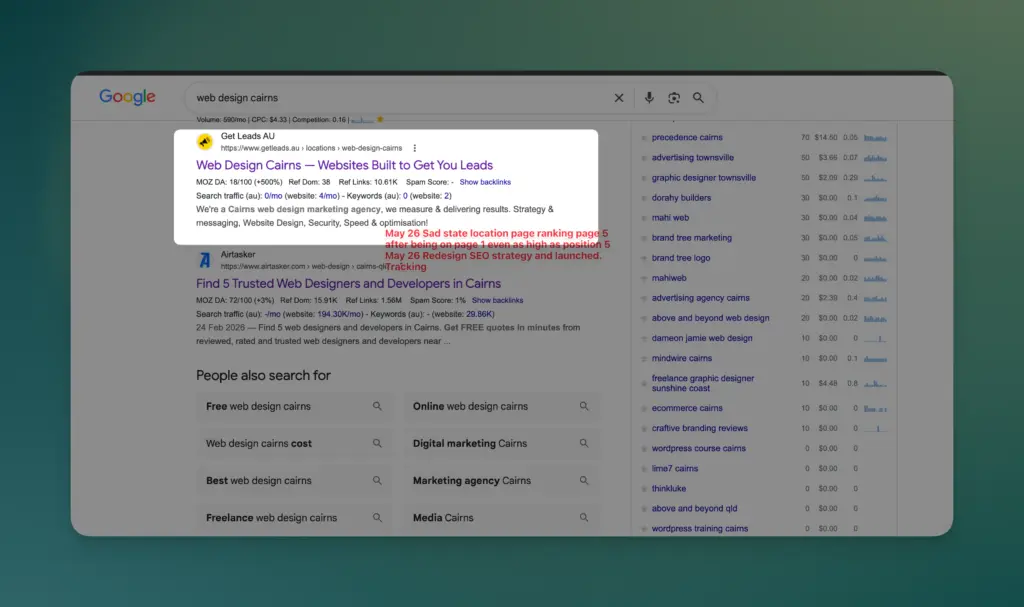
Three years into running Get Leads, I’ve spent the last two weeks doing a proper deep dive into what’s actually working in local SEO in Australia right now — specifically for my own situation: a business based in Cairns in FNQ, most of my existing clients in Wagga Wagga, and a need to rank meaningfully in both markets. I’m struggling to rank for SEO Cairns and Web Design Cairns despite having loads of experience. Way more than most of the agencies in the area.
Oh dear, how is this going to work was the big question. From other blog posts on SEO in the area readers may understand Cairns is short on every tradie but they sure aren’t short on web designers and developers.
Let me give you a clearer picture about my initial challenge. Wagga, 2-3 decent competitors with 60k population, Cairns, 30+ competitors 160k population. All of a sudden I’m up against 10x the competitors and some with large teams that have been around for a long time.
I ran competitor research through Ahrefs and used Claude as a thinking partner to make sense of what I was seeing. Here’s every real finding, in plain language — the stuff that shaped my Cairns local SEO strategy for 2026.
As of 3 June 2026 things that are working:
- Targeting search intent in different areas for AI and AEO
- Content and user intent is key
- Optimising those pages that are ranking in AI crawling especially if they have local intent
- GMP Reviews are holding so much weight for local business search
- Service pages and attached schema and service sub-pages
- Domain based local is unfortunately playing a part with the old .com.au beating .au on gains. We haven’t really seen this in the past other then speculation noting amazon.com.au ranking better than amazon.com. It would be interesting if an amazon.au ranked as high or higher.
What’s not working:
- Blogs
- Location pages
- Industry or Category pages
- FAQ schema
- Backlink value is become more and more limited regardless of follow or dofollow authority is a part of the overall picture but not as relevant on the May 2026 rollout.
The dead ends — what the data confirmed isn’t working
1. Location pages are not ranking pages
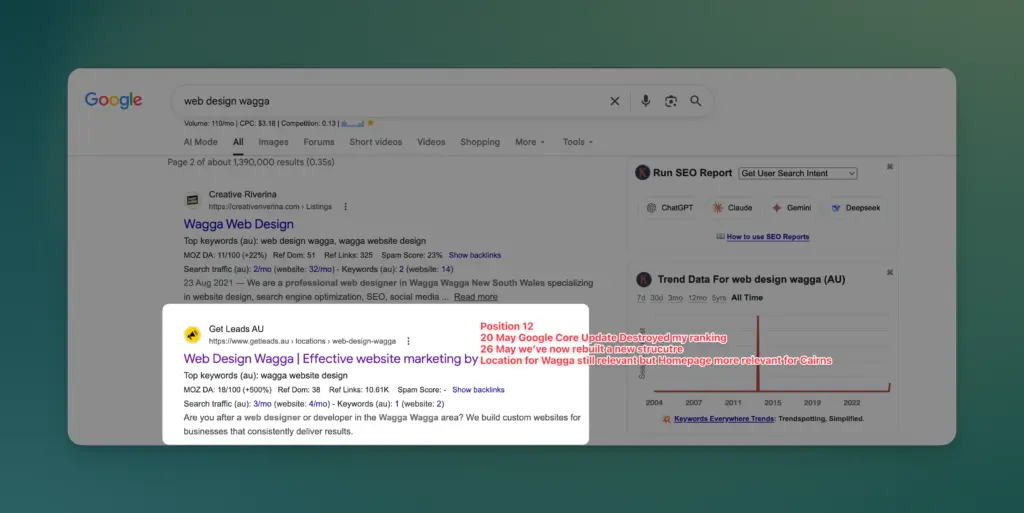
I’d been running location pages for Wagga and Cairns as a core part of my SEO services strategy — and I suspected they might be underperforming. Pulling competitor data through Ahrefs confirmed it. Across multiple competitor marketing agency sites using this exact approach, none were getting meaningful traffic to their location pages.
Confirmed dead!
Location pages might add a thin layer of geographical relevance to your SEO, but they should not be your primary ranking vehicle. The data backs this up — no traffic, regardless of effort.
2. Industry pages: a lot of work, very little return
I saw this repeated across several competitor designer sites — mainly actually web developer type agencies had put real effort into unique, well-written industry pages (tradies, medical, hospitality, etc.). The Ahrefs traffic data told a consistent story: next to no visitors, regardless of content quality.
Not worth the investment
Industry-specific landing pages are a vanity play in 2026. The SEO return does not justify the production cost, and Ahrefs data across multiple sites confirmed this pattern consistently.
3. Blogs have diminishing returns — and most of mine got deindexed
Around February and March 2026, almost all of my blog posts were dropped from Google’s index. The ones that survived were question-based articles — things like “How do Cairns businesses rank for SEO in 2026?” Informational, specific, answering a real query. You might be thinking that’s due to poor quality but most of these have been manually written and not generated. Planned with unique details and stats.
Changing fast
Blog posts offer a short freshness window and limited lasting power in local SEO. Topic clustering also shows weak results unless you’re publishing daily. Write question-based content or don’t bother — this article included.
The structural work — what actually moved things
4. Link juice from the homepage matters more than I gave it credit for
getleads.au has a solid backlink profile pointing to the homepage at the moment we’re around the 20 mark which is the second largest for Wagga and would get us on the front page for Cairns. Links on our homepage footer, header pass authority outward through every link on that page — including header and footer navigation, which appear consistently across the entire site. Understanding this changed how I think about menu structure entirely.
The insight
Your header and footer links are distributing link juice constantly to wherever they point. For any SEO agency or local SEO services site, this is worth auditing before anything else. Every persistent link is receiving a share of your homepage’s authority — choose them deliberately.
My profile had equal authority being pushed and more importantly shared to pages like Tumut, Griffith and other minor volume locations.
5. Google wants one location — the single-location problem in local SEO Australia
Google’s local ranking model is built around a single primary location. For a business targeting both Cairns SEO and Wagga Wagga — that’s genuinely awkward. The clean solution is separate sub-sites, but that’s a slow burn: new domain authority, new backlink building, months of patience before meaningful google local ranking movement.
My workaround: keep the Wagga location page (it ranks okay), but shift the homepage itself to carry more Cairns-weighted keywords. Rather than splitting effort across two location pages, I concentrated it at the homepage level — where the authority actually lives.
Local SEO Australia reality
If you’re trying to rank for local SEO across multiple cities without sub-sites, your homepage has to do more of the geographic heavy lifting. Location pages alone won’t cut it in 2026. Service clusters instead look to be getting more Google love.
6. Pruning footer links to low-population towns
I had footer links to Griffith, Young NSW, Tumut and a handful of other regional centres. These were consistently diluting the authority push toward my two primary pages — Cairns and Wagga. Removing them tightened the flow considerably.
Quick win
Cut footer links to locations you’re not seriously targeting. Every extra link splits the link juice your homepage distributes. Less is more when it comes to footer navigation in a local SEO strategy.
7. Redirects were bleeding link equity — 12 of them
If link juice is a real thing (and the evidence says it is), making it hop through a 301 redirect before reaching its destination is wasteful. I found 12 redirect chains where internal or inbound links were pointing to URLs that had since moved — each hop losing a fraction of the equity. Every one was updated to point directly to the live endpoint.
Technical
Audit your inbound and internal links regularly. Redirect hops lose authority at each jump. Always link to the final destination, not the redirect — this is one of the most overlooked issues in local SEO services work.
8. Service pages are doing the heavy lifting
This was the biggest finding of the whole exercise. Service pages — even clustered ones — are helping with relevance in a way that other page types simply aren’t in 2026. I went further and added deliberate location blocks to two of my key service pages: a primary Cairns reference and a secondary Wagga one. Not watering it down — being intentional about location context within pages that already have authority flowing to them.
Biggest mover
Service pages with embedded location context are the most reliable SEO asset right now. For any SEO agency in Cairns or elsewhere — build them well, link to them from the homepage, and don’t sacrifice them for blog output.
Speed — a different approach this time
9. WordPress still wins on technical performance
I’ve always maintained fast sites — and that gives a genuine edge in local SEO. The issue for designers is that speed is a technical problem, and many outsource it to platforms like Squarespace, expecting it’s handled automatically. Sorry, it isn’t. The fundamental architecture of those platforms will never match a properly optimised WordPress setup. This is one area where how to rank higher on Google maps and in organic search converges — site speed affects both.
10. Claude diagnosed rendering issues we didn’t know existed
Instead of chasing Core Web Vitals metrics in isolation, I was disillusioned both in the lighthouse tests and page.dev speed tests. Both seemed good, I was getting A plus rating however we used Claude to work through the actual rendering behaviour of the site systematically. The top recommendation: Cloudflare caching — which we’d pulled back on previously because a stale cache was causing development friction.
The cache development fix
We set up Cloudflare cache rules to manage staleness, then built a one-click API call into the Get Leads site to flush the external cache on demand. Development friction gone. Cache performance benefits back. A small technical fix with real SEO implications. If you’re implementing this add rules and make sure that you’re exclude rule is at the bottom of the priority list not the top. I chased my tale on this for a solid day.
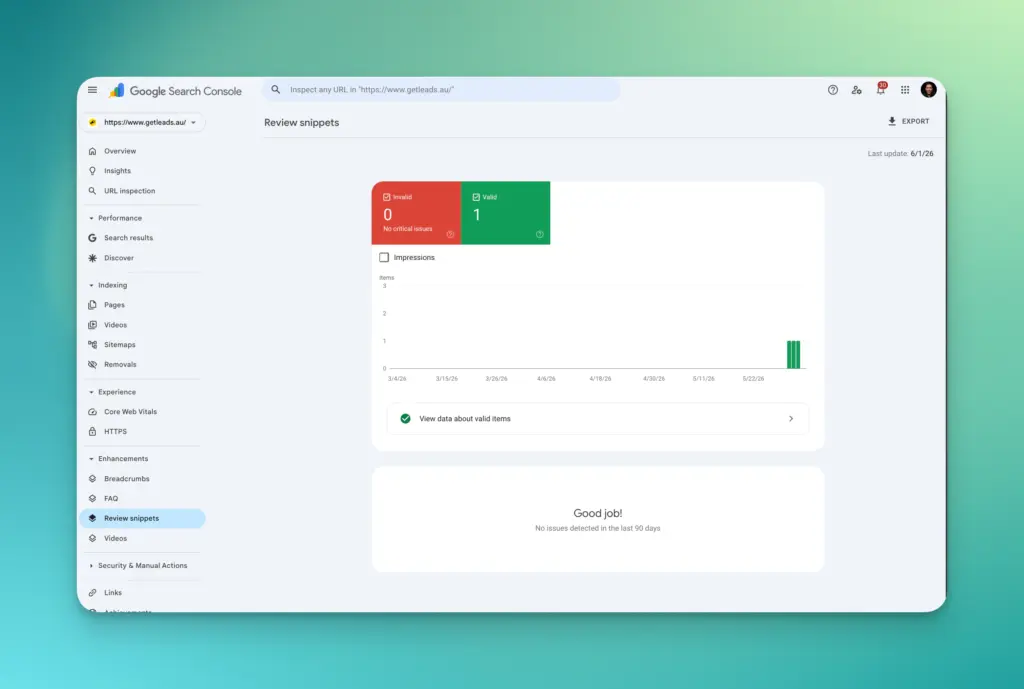
11. Customer Rating Schema is picked up again
You can definitely see a clear picture from the Google Core update on the 21st May 2026 that is less aligned to professionally built techniques like location pages and blogs and leaning more on local pack to inform Google to get ranked moving to user recommendations.
From Google with so many layered techniques adding up to a rank the actual update had some other key things that have popped up on my site and my customers. I like to see patterns in order to make clear decisions.
Years ago I had added some schema for my Google My Profile reviews and displayed this on my location pages with the hope that Google would use it. I actually forgot to make this update automatically but it was there. While it’s been dormant for a while in this last update on the 30th May it all of a sudden pops up as being used in rich search results. This then led me to apply the same schema to service and portfolio pages. See below my screenshot of GSC.
The tools that made this possible
12. Using the Ahrefs MCP with Claude is a genuine game changer for SEO in 2026
Connecting Ahrefs through the MCP integration and running analysis directly in Claude has changed how I approach competitor research and local SEO strategy entirely. Rather than exporting CSVs and trying to make sense of them separately, I can ask strategic questions against live keyword and backlink data. It’s made profiling what’s working in local SEO Australia far faster — and equally important, it confirms what’s a waste of time before you invest in it.
The amazing SEO combo
Ahrefs gives you the data. Claude helps you think clearly about what to do with it. For any SEO agency or business owner trying to build a local SEO strategy in 2026 — this pairing is the most efficient research setup I’ve used in three years.
The big picture — balancing what’s important vs what works
My situation at Get Leads is genuinely unusual. I want to target both Cairns SEO and Wagga Wagga, but the location-based strategy I ran for three years — starting almost exactly when the business launched — has been declining in effectiveness since around 2023. That’s the year I launched and it’s taken me 3 years to figure out Google decided to penalise me because I chose this strategy. That’s a hard thing to sit with after that much investment.
What came out of these two weeks is a clearer hierarchy: service pages first, homepage authority second, location signals embedded deliberately in both rather than isolated on their own pages. Blogs for freshness only, with question-based framing when they’re worth writing at all. And a much tighter approach to where link juice flows across the site.
Local SEO strategy and what actually moves google local rankings can be genuinely at odds with each other. I found that out the hard way. If you’re running a Cairns business — or any regional business trying to balance multiple locations — the Get Leads homepage is where to start a conversation about what’s working right now.
Last of all, one last piece of advice for those marketers out there struggling with gaining traction with customers. Your best leads don’t come from organic traffic or ads. While ranking number 1 for “website design cairns” is a goal of mine I’m realistic on how new customers make a decision to spend 6-10k on a web designer. Getting the top spot for this is only for bragging rights. News, it’s word of mouth or through networking and not through spending 20k on ads on Facebook or Google.
Let’s check back here on the 26th June and see what’s happened with our ranking.