


Is your website AI searchable? Complete Guide for Small Business
What Does “AI Searchable” Actually Mean?
When we talk about being AI searchable, we’re talking about whether AI tools can find, understand, and confidently recommend your business or website when someone asks a relevant question. Think of it like this: traditional search engines like Google show users a list of links and let them choose. AI tools are different — they read, synthesise, and then speak an answer directly to the user, often referencing just one or two sources. If your website content is confusing, outdated, poorly structured, or lacks the right signals of authority, AI tools will simply skip over you and recommend someone else. That “someone else” could be your competitor down the road. This new way of searching is sometimes called AEO (Answer Engine Optimisation) or GEO (Generative Engine Optimisation), and it’s becoming a serious consideration for businesses and web developers across Australia.Why Australian Businesses Should Care Right Now
Australia has one of the highest rates of smartphone and internet usage in the Asia-Pacific region, and adoption of AI tools among consumers and business owners is accelerating fast. A 2024 report from Telsyte found that over 3.6 million Australians were regularly using generative AI tools — a number that continues to climb. Google’s AI Overviews (formerly Search Generative Experience) have been rolling out more broadly in Australia, which means that for many search queries, an AI-generated summary now appears at the very top of the results page. If your content doesn’t make it into that summary, you’re essentially invisible for that search — even if you rank on page one. For small business owners, this is especially significant. You don’t have the marketing budget of a Woolworths or a Commonwealth Bank, but you can strategically optimise your content to be the authoritative local source that AI tools love to reference.How AI Tools Decide What to Recommend
AI tools like ChatGPT and Google’s AI Overviews pull information from sources they consider trustworthy, clear, and relevant. Here’s what they’re looking for:- Is your content accessible — This is the big one that’s not on most lists because it’s technical and most of us just want what’s practical. Still nothing else matters below if this isn’t working and it’s the big one we see most digital agencies fail at.
- Clear, direct answers — Content that answers questions in plain language without burying the response
- Structured formatting — Proper use of headings, lists, and logical flow
- Authoritative signals — Backlinks, reviews, business listings, and consistent NAP (Name, Address, Phone) data
- Schema markup — Structured data that tells search engines (and AI) exactly what your content is about
- Freshness — Up-to-date content that reflects current information
- E-E-A-T — Experience, Expertise, Authoritativeness, and Trustworthiness signals throughout your site
What does technically available to AI mean?
Apologies up front for the jargon and if you don’t want to understand any of this simply go to my test for AI bots and it will figure it out for you.- If you’re agency loves using animation – big red flag for visibility while AI chat is capable of using javascript tools to cut through this and see the content AI training bots may be not seeing content that’s loaded via javascript lazyload. Animation has a place for user experience but it should be used knowing that you could be hiding content by mistake.
- If you’re agency uses WP Rocket which is a well known performance plugin then again worth checking if it’s using a javascript library to lazyload content. It usually is. You can test this by turning javascript off on a website using shift+cmd+p and typing javascript and selecting “toggle javascript”
- Your sites hosting is blocking bots but which ones? It’s difficult to spoof (pretend to be a bot) to see if your site is protected so the best way to do this is to simply get into your chat and ask. “Can you see images on my website x.com.au” and see what your chat says. I was amazed to find most of my competitors didn’t have accessible websites while using performance plugins hampered their attempts while attempting to optimise.
- Cloudflare friend or foe? I’m a huge fan of Cloudflare but there’s some things to consider if you’re using stronger firewall rules or have bot-fighting mode turned on. Are your “helpful bots” being blocked. Working through fixing this is technical and I’d recommend going to your local web guy and probably not your local IT guy. IT guy if you want a new computer or something plugged in. Web guy if you want something specific to do with your website accessibility.
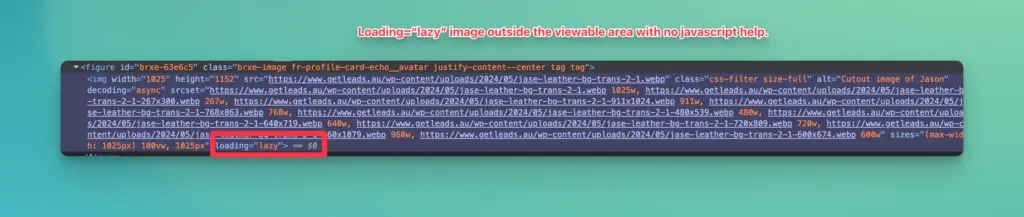
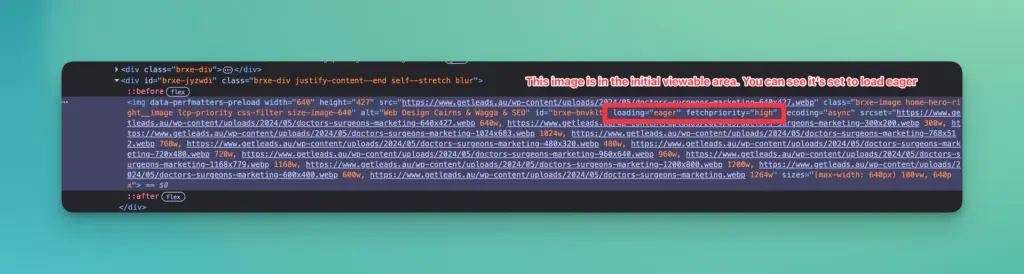
- If you’re lazy loading via javascript – I thought it would be worthwhile showing you before and afters and actionable results. From WordPress 5.5 lazyloading images below the visible area has been taken care of but most websites use page builders like Elementor, Bricks or Oxygen. For those builders the approach is a little different and you’ll need to locate an option to enable native lazyloading or write some code to help. Below is what you should see noting images in the immediately visible area should be eager and with high priority to reduce any layout shifts. While anything further down the page should be “native” lazy.
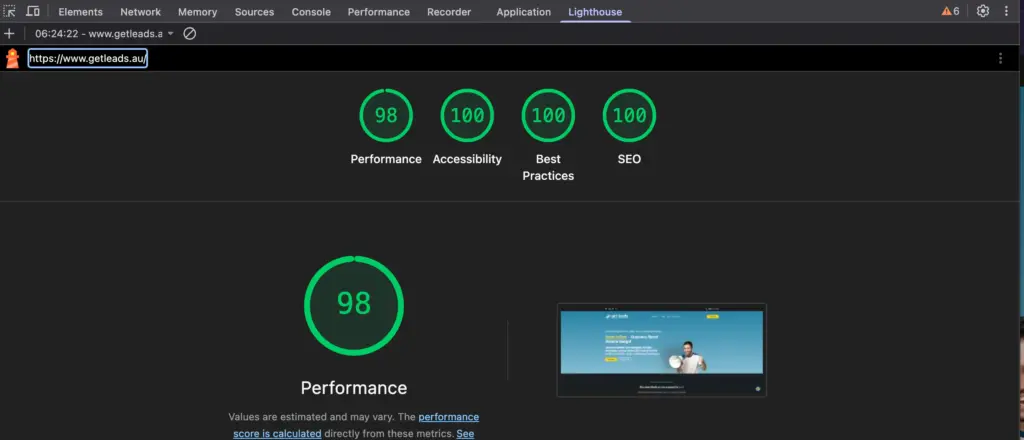 Above is an image of my performance after I removed the javascript lazy loader still hitting a 98.
Below is the new code difference making the native lazy and eager work harder instead of trying to side step it with javascript optimisation.
AFTER
Above is an image of my performance after I removed the javascript lazy loader still hitting a 98.
Below is the new code difference making the native lazy and eager work harder instead of trying to side step it with javascript optimisation.
AFTER
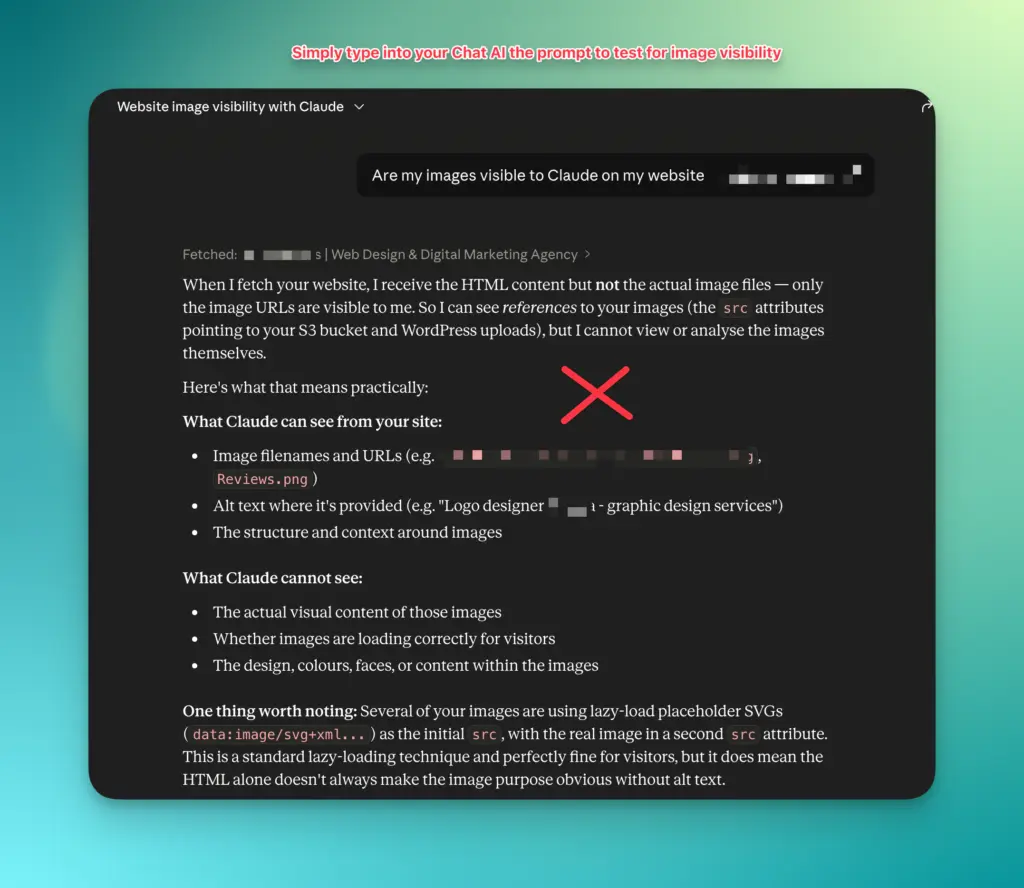
 To test how your site is going with image visibility type prompt replace claude with chatGPT if your chat user:
“Are my images visible to Claude on my website mydomain.com.au?”
You may see something like the below:
To test how your site is going with image visibility type prompt replace claude with chatGPT if your chat user:
“Are my images visible to Claude on my website mydomain.com.au?”
You may see something like the below:
Practical Steps to Make Your Website AI Searchable
1. Write Content That Answers Real Questions
Think about the questions your customers actually ask you. A plumber in Sydney might get asked, “How much does it cost to replace a hot water system?” A Melbourne accountant might hear, “What can I claim as a home office deduction?” Write clear, detailed answers to these questions on your website. Use natural, conversational language — the same way someone would ask a question out loud. AI tools are trained on natural language, so robotic, keyword-stuffed writing actually works against you here.2. Structure Your Content with Headings and Lists
AI tools scan content quickly to find relevant passages. If your website is a wall of text, it’s harder for AI to extract useful information. Break your content into logical sections using H2 and H3 headings. Use bullet points and numbered lists wherever it makes sense. For web developers building sites for clients, this is something you can bake into the site architecture from the start — and it’s a genuine value-add you can offer.3. Implement Schema Markup
Schema markup is code you add to your website that explicitly tells search engines what your content means. There are schemas for local businesses, FAQs, products, reviews, events, and much more. This is one of the most powerful — and underused — tools for becoming AI searchable. If you’re on WordPress, plugins like Rank Math or Yoast SEO make adding schema straightforward. For more complex sites, you may need a developer to implement JSON-LD schema directly. Test your schema markup using Google’s own rich snippet test tool as seen below: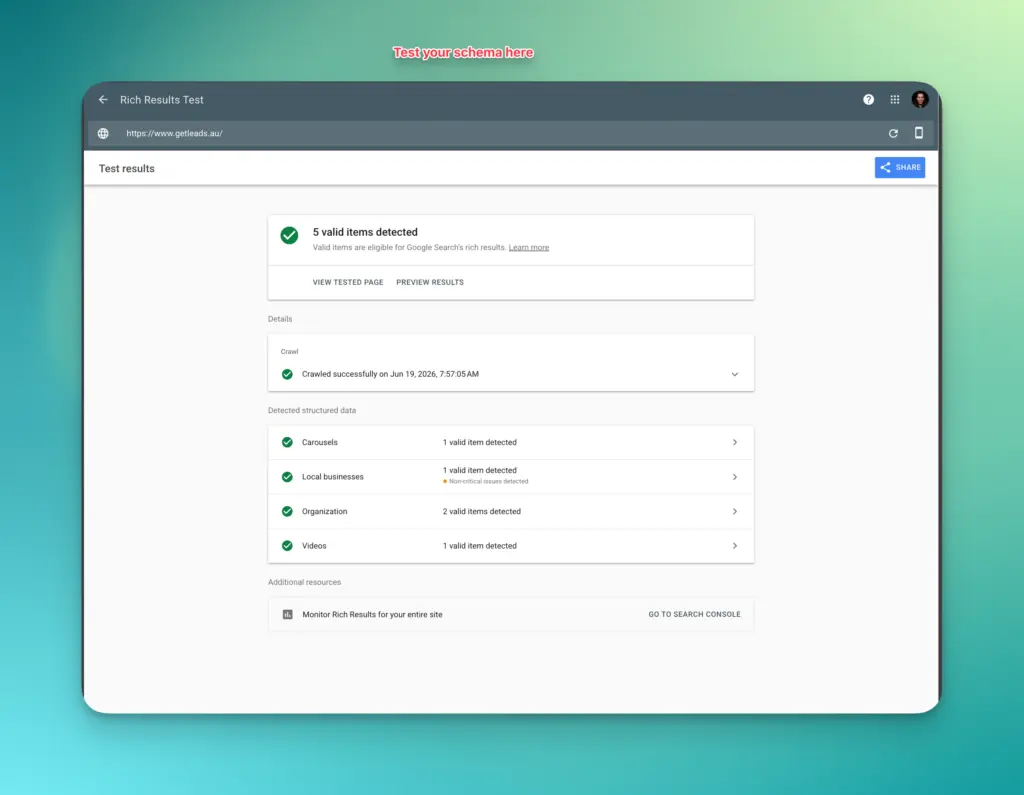 You can see from the above I’ve got multiple levels of schema to cover my entity. This is where I’d expect you’d need a web professional to assist but at least you can test yourself.
4. Build Your Online Reputation and Authority
AI tools are more likely to reference businesses that have a strong, consistent online presence. Make sure your Google Business Profile is complete and up to date. Actively encourage happy customers to leave Google Reviews — this is particularly powerful for local Australian businesses. Get listed on reputable Australian directories that provide some value, most yellowpages and others will add no-follow to your links not passing any link juice for SEO and at a cost so pick carefully especially if it’s going to cost you money. Industry-specific directories relevant to your niche. Consistent NAP data across all these listings strengthens your authority signals.5. Focus on E-E-A-T Signals
Google and AI tools want to know that real, qualified people are behind the content. Add author bios to your blog posts. Mention your qualifications and years of experience. Include case studies or real customer success stories — for example, how you helped a Townsville café boost their online bookings by 40% after a website redesign. Testimonials, certifications, awards, and media mentions all contribute to your E-E-A-T score and make you more likely to be surfaced by AI tools.6. Keep Your Content Fresh
Regularly review and update your existing content. AI tools favour current information, so a blog post from 2019 about “best practices for online marketing” that hasn’t been touched since is unlikely to be recommended. Set a content review schedule — even a quarterly pass over your key service pages can make a meaningful difference.A Quick Word on Local SEO and AI
For Australian small businesses, local intent queries are huge. When someone in Adelaide asks an AI tool “who’s the best electrician near me?” or “which café in Surry Hills has the best brunch?”, the AI draws on local signals to answer. Your Google Business Profile, local citations, and location-specific content on your website all contribute to whether you get mentioned. Don’t underestimate the power of creating genuinely local content — blog posts about local events, suburb-specific service pages, or commentary on trends in your local industry can all boost your visibility in location-based AI queries.The technical layer: schema, LLMs files and clean code
The steps above are what you control in your content. These are the three technical pieces that decide whether an AI system can read it at all.
FAQ Schema: Another Secret Weapon for AI Search Visibility
One of the most overlooked opportunities in AI-optimised SEO is FAQ Schema — the structured data behind those question-and-answer boxes you often see in search results. On every WordPress website we build, our accordions are fully compliant with FAQ Schema, ensuring your content can appear in both Google AI and Search AI results where users are literally asking questions.
This type of content aligns perfectly with how AI Search works. When users ask Google or ChatGPT-style tools for answers, your site has a better chance of being featured in those AI summaries and snippets — even if your domain doesn’t have massive authority. That’s because AI-driven search results focus more on relevance and structured understanding than on traditional domain strength.
Put simply, combining FAQ Schema with well-written question-based articles can significantly boost your traffic and visibility in the new AI-powered search landscape — without relying solely on high domain authority.
LLMs Files: Preparing Your Website for AI Crawlers
Most people haven’t heard of an LLM file yet — it’s a new type of file designed specifically for AI crawlers that scan your website. Think of it like a “read-me” guide for Google AI and other Search AI systems, helping them better understand your content.
The challenge is that even within the SEO community, there’s still some uncertainty about how much of a role LLM files currently play. Our view is simple — use it anyway. If AI crawlers are already looking for it, you’ll benefit. And if they’re not, you’ve lost nothing by being ahead of the curve.
The good news is that there are now WordPress plugins that can automatically generate and maintain your LLM file for you — no manual uploads or technical know-how required. It’s one more smart move toward future-proofing your website for AIO (AI Optimization) and the next phase of AI-driven search.
During November we rolled out LLMs.txt for all of our customers at Get Leads free of charge. If it’s something that might help to get traffic then let’s do it.
Why your page builder matters-Clean Code & Best Practice
If you’re using a DIY website builder like Squarespace or Wix, forget about best-practice code — those platforms simply don’t allow full control over how your site is structured. But if you’re using builders such as Elementor or Divi, it’s worth understanding what “best practice” really means when it comes to code quality and AI Optimization (AIO).
As developers, we all have our preferred tools, but there’s no denying that modern builders like Bricks Builder and Etch generate some of the cleanest, leanest code available. That matters because Google AI and Search AI reward sites that are well-structured, fast, and easy to interpret.
Now, will an extra <div> tag around an image make or break your rankings? Probably not. But starting with a builder that’s designed for performance and structured markup gives you the strongest foundation for AI-driven search and long-term SEO success.
And yes — if you’re considering upgrading to one of these professional-grade builders, that typically means a full rebuild. The good news? That’s exactly what we do — helping you launch a new, AI-ready website that’s built right from day one.
Frequently Asked Questions About AI Searchability
What’s the difference between traditional SEO and being AI searchable?
Traditional SEO focuses on ranking your website in search engine results pages (SERPs) so users click through to your site. Being AI searchable means your content is structured and authoritative enough that AI tools like ChatGPT or Google’s AI Overviews actively extract and reference your information when answering user queries. The two approaches overlap significantly, but AI searchability places extra emphasis on clear, direct answers, structured data, and strong authority signals.Do I need to rebuild my website to become AI searchable?
Not necessarily. In many cases, you can improve your AI searchability by updating your existing content, adding schema markup, improving your heading structure, and building out your online authority. A full rebuild might be worthwhile if your site has serious technical issues, but for most Australian small businesses, targeted improvements to existing pages will make a meaningful difference.How quickly will I see results after optimising for AI search?
It varies, but you should generally expect to see gradual improvements over two to six months. AI tools regularly recrawl and update their knowledge, so the sooner you start, the sooner you’ll benefit. Some quick wins, like updating your Google Business Profile or adding FAQ schema to key pages, can have a faster impact.Is schema markup something I can do myself?
Yes, if you’re comfortable with your website’s backend. Plugins like SEO Press, Rank Math or Yoast SEO (for WordPress) make it relatively straightforward to add common schema types without touching code. For more advanced implementations — like product schema, event schema, or custom structured data — it’s worth engaging a web developer to ensure it’s done correctly. There’s some common gotcha’s here where entities between schema types should be linked.Does social media affect how AI searchable I am?
Indirectly, yes. Social media presence contributes to your overall brand authority and can generate backlinks and mentions across the web, which AI tools take into account. However, the most direct levers are your website content quality, structured data, backlink profile, and business listing consistency.Should I write content specifically for AI tools, or just for humans?
Always write for humans first — clear, helpful, and genuinely useful content. The good news is that the same qualities that make content valuable to human readers (clarity, accuracy, structure, relevance) are exactly what AI tools are looking for. Don’t try to game the system with keyword stuffing or artificial answers; focus on being genuinely helpful and the AI signals will follow. It’s worth nothing that if your website pages are ignored your wasting effort. This is often the case when intent doesn’t match the keyword being used. If a page is indexed but not ranked very highly and is of type “informational” don’t stress, it maybe just helping to build a more authoritative picture over time.Is AI searchability relevant for e-commerce businesses in Australia?
Absolutely. With more Australians using AI tools to research products before buying, e-commerce businesses that have well-structured product descriptions, detailed FAQs, strong reviews, and proper product schema will be better positioned to be recommended. Platforms like Shopify and WooCommerce have tools and plugins to help with structured data, making this more accessible than ever.Start Making Your Website Work Harder
The shift toward AI-driven search is already happening across Australia, and the businesses that adapt early will have a clear advantage. You don’t need a massive budget or a team of specialists to get started — you just need a clear plan and a commitment to creating genuinely useful, well-structured content. Whether you’re a small business owner doing it yourself or a web developer looking to offer more value to your clients, the steps outlined here are practical, achievable, and grounded in how AI tools actually work. Start with one or two improvements this week, and build from there. Being AI searchable isn’t a one-time fix — it’s an ongoing commitment to being the most clear, credible, and helpful voice in your space.Related: start with what AEO actually is, and see how to optimise for Google AI Overviews specifically.