

What is AEO? Answer Engine Optimisation Explained
You’ve invested in your website. You’ve worked on your SEO. But something has shifted in the way people search — and if your digital strategy hasn’t kept pace, you’re likely invisible to a growing segment of your audience.
Welcome to the era of Answer Engine Optimisation, or AEO. For ambitious entrepreneurs who want websites that grow business, understanding and implementing AEO strategies isn’t optional anymore. It’s the next competitive frontier. Ranking for AEO is a far more complex topic where each LLM favours numerous different sources to give a source authority.
So, What Exactly is AEO?
Answer Engine Optimisation (AEO)is the practice of structuring and presenting your website content so that AI-powered answer engines — think ChatGPT, Google’s AI Overviews, Perplexity, and Siri — can extract, understand, and surface your answers directly to users.
Whats the goal of AEO?
The goal of AEO is making it easy for AI to find answer to problems that a user might be asking. For optimisation it’s about front loading answers to questions quickly in articles like this one is exactly what its looking for. When done properly it positions your brand, such as Get Leads AU, as the go-to source for answers that are given in a conversational UI vs. hours of searching organically.
Why AEO Strategies Matter for Business Growth
Consumer search behaviour has fundamentally changed. More people are asking conversational questions — spoken or typed — and expecting a direct, intelligent answer rather than a list of blue links to sift through.
For entrepreneurs scaling from six to seven figures, this shift is significant. When a prospective client asks an AI assistant, ‘What’s the best Web Design provider in Cairns?’ — will your business be the one that gets named?
The funny thing is here that different LLMs will give different answers and even different answers for different people by location. The intent of the searcher here is similar to that of a user profile for search history which can also vary Google Organic search results. Optimising for all LLMs is ideal and not at odds with each other.
Effective websites are no longer just visually compelling or technically sound. They’re built to communicate with both human visitors and AI systems simultaneously. Businesses that invest in AEO strategies now are positioning themselves to dominate a channel their competitors haven’t even discovered yet.
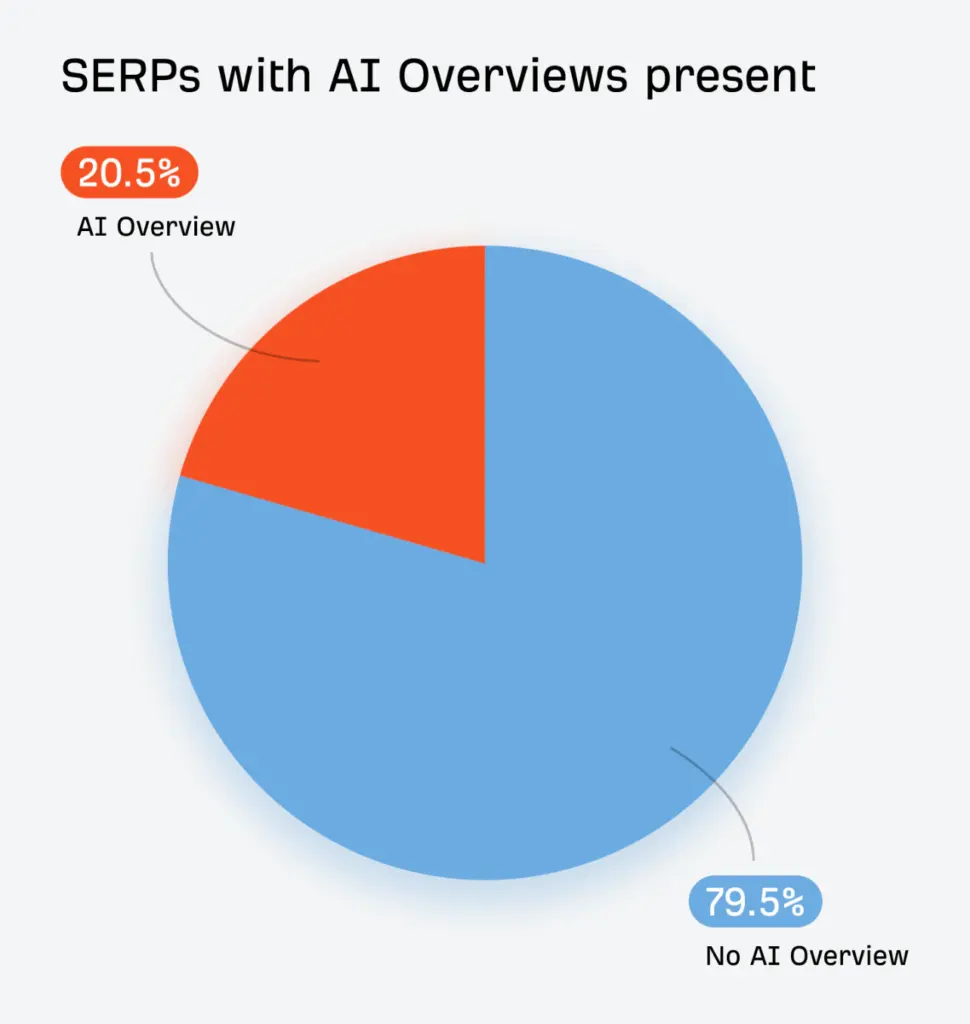
In the graph above Source AHREFs Ryan Law on the 10th of November 2025 reported that over 21% of search now involved AI Overviews this is a growth from a report from SEM Rush in March of 2025 reporting 13.14%. It might not seem like much but this increase is significant. The main area this doesn’t affect “navigational” or where a brand search has been conducted where someone is potentially not a cold customer.
What happens if you don’t optimise for AEO?
While authorities like Gartner have predicted a 25% decrease in 2025 this more up to date analysis means it’s no longer a prediction. During the roll out of Google Core Updates in March and May of 2026 we saw a significant decrease in organic traffic by 50% in some cases. While this was the case in traffic we also saw an increase in clicks. How could this be? Well traffic was connected by other means and while organic has always been a stable high performing area for a lot of websites the value of the users intent behind the click on whatever platform that is increased.
As organic declines it’s therefore clear to see If you don’t optimise for AEO this is an area you’re missing out on. It’s therefore necessary to diversify across sources. This is exactly what Google wants with an increase in Google ads having also increased in the last couple of months. We now see Ads, top middle and bottom of our resulst.
A study from Illumination Marketing reported that over 400 million people use Open AI products every week and that was in 2025. By now in 2026 there would be far more.
How AEO Actually Works: The Core Principles
Implementing AEO strategies successfully comes down to a handful of foundational principles:
- Structured, Question-Based Content: AI answer engines scan for content that directly addresses how real people phrase questions. Your website needs pages, FAQs, and blog content written in natural, conversational language that mirrors what your audience is actually asking. It’s worth nothing here that while Google still uses FAQ schema for some sites it’s been depreciated for many smaller sites. Google Essentially doesn’t need it to understand your HTML question/answer formats.
- Schema Markup: This is the technical backbone of AEO. Schema markup is a form of structured data code added to your website that tells search engines and AI tools exactly what your content means — not just what it says. Think of it as labelling your content in a language machines speak fluently.
- Authority and Trust Signals: AI systems prioritise sources that demonstrate expertise, authoritativeness, and trustworthiness. This means consistent NAP (Name, Address, Phone) data, credible backlinks, verified business profiles, and well-structured content that references reliable information.
- Concise, Direct Answers: Answer engines look for the clearest, most direct response to a query. Dense paragraphs and vague claims won’t make the cut. Websites that perform well in AI search are those that lead with the answer and support it with context.
AEO vs SEO: Partners, Not Competitors
A common misconception is that AEO replaces SEO or is something else entirely. It doesn’t — it builds on it. Your existing SEO foundations, strong content, technical performance, mobile optimisation, and quality backlinks, all feed into your AEO readiness.
Think of it this way: SEO earns you visibility on the search results page. AEO strategies earn you the featured position inside the answer itself. Both are essential components of websites that perform in today’s digital landscape.
The entrepreneurs winning online aren’t choosing between the two. They’re integrating both into a unified content and technical strategy. SEO is the base and the most valuable while AEO becomes more of a strategy within the toolset.
For example, this article was written with lists. Why? not just because it’s easier to read and while that’s true our SEO tools told us that Google matches our keyword “What is AEO?” with articles that use dot-points and in addition to that shorter the better. BLUF is what wins here or Bottom Line Up Front.
Getting Started: What Your Website Needs to Compete
If you’re serious about leveraging AEO strategies, here’s where to focus your energy:
- Audit your content: for conversational, question-led language. Rewrite where needed.
- Implement schema markup across key pages — especially service pages, FAQs, and about sections.
- Build out a structured FAQ section that mirrors real customer queries in your niche.
- Strengthen your authority signals (hardest) — seek quality mentions, keep business listings accurate, and publish credible, well-researched content consistently.
- Prioritise page speed and mobile performance — AI tools favour technically excellent websites.
These aren’t cosmetic changes. They’re architectural upgrades that transform good websites into effective websites built to capture the future of search.
A little more on auditing your content unique to this article
Have you considered how SEO’s pick keywords? Is it volume, difficulty, relevance to the topic cluster? Well it could be all those things but we take things a step further and assess your competitors intent mix. We match topics, keywords, intent and what is called SERP features or Search Engine Results Page features so that we’re more likely to not have our content ignored. We’ll audit your page inventory and your competitors page inventory to determine what’s actually indexing by Google and what’s being ignored.
In a recent study here in Cairns I audited content intent for competing agencies blog silos and found that most agencies only had 2-3 blogs actually indexed out of possibly 100. Why? Intent doesn’t match the best answer format Google is searching for. Consider a questions type blog that answers a question like this one. Structure of most blogs see the answer placed at the bottom instead of the top. Or another example “How do I” may have a SERP feature of video but a narrative boring text blog was written with that topic name.
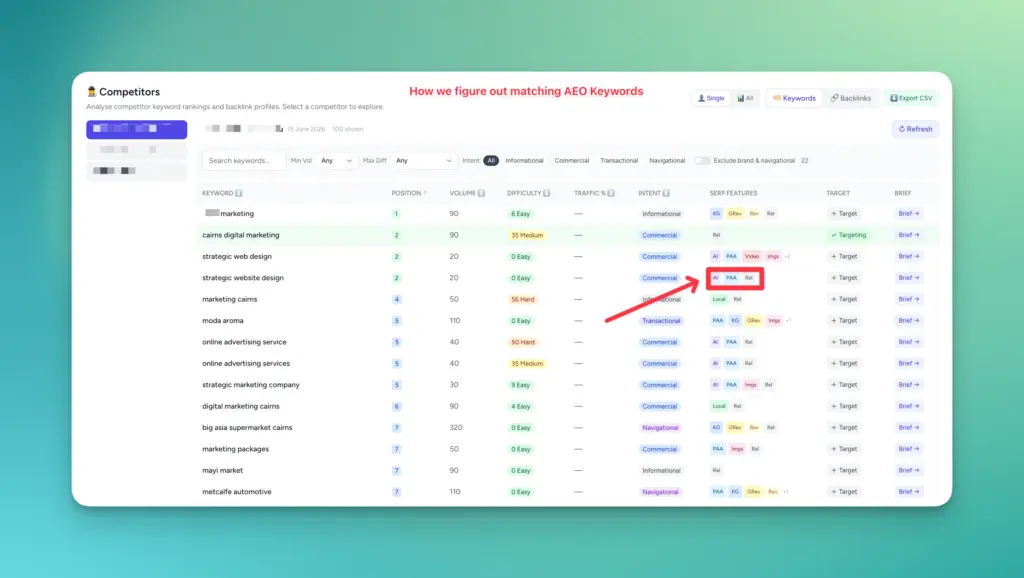
The above screenshot is from our Content Flow system which analyses competitor keywords and SERP for that keyword, difficulty so we know before we put any effort in if we’re going to rank for it.
Audit to match SERP and format
Matching intent, SERP, difficulty and format is what matters to rank a keyword for a specific website. For alot of competitor examples as a digital agency brand keywords also need to be excluded which are usually a “navigational” based intent. AI results that feed into our AEO are tagged like in this one here.
AEO strategies represent one of the most significant shifts in digital marketing since mobile-first indexing changed how Google ranked websites. For ambitious entrepreneurs who want to scale without wasted effort, this is a high-leverage opportunity. The businesses that act now — building AI-ready, answer-optimised digital presences — will be the ones earning trust, visibility, and leads from the next generation of search. The question isn’t whether AEO matters for your growth. It’s whether you’ll move before your competitors do.
Ready to build a digital presence that speaks to both your customers and the AI tools they rely on? Our team specialises in designing and developing effective websites that are engineered for performance from the ground up — including full AEO and SEO integration. Book your free growth strategy consultation today and discover exactly what it takes to build websites that grow business in the AI era.
Best of luck and remember to track where you’re at and set a goal for where you want to go.
Next steps: check whether your website is AI searchable, then optimise for Google AI Overviews.