

Custom vs Template: When Cairns Businesses Should Invest in Bespoke Development
Every Cairns business owner hits the same question when it is time to build: custom, or template? The honest answer depends on where your business actually is right now, not on which option sounds more impressive. Effective websites are not a budget decision, they are a strategy decision, and the wrong call will either accelerate your growth or quietly become the thing holding it back. What follows is a framework based on business reality rather than generic advice, plus a fair account of what tends to go wrong with templates once the launch glow wears off.
The template sweet spot: when standard solutions work
Templates are not the enemy. For a lot of businesses they are a sensible starting point. If you are a new Cairns business with under 10 employees, straightforward service offerings and a need to establish credibility quickly, a well-executed template can be your launchpad.
The key is execution. A professionally customised template that loads fast, converts visitors and reflects your brand beats a poorly planned custom build every time. Think of the template as the foundation. What matters is how strategically you build on top of it.
Consider the local Cairns accountant who launched on a quality template, put their budget into content strategy and local SEO instead, and generated 40+ qualified leads in their first quarter. Smart resource allocation beats custom development when you are still proving market fit.
What 20 years of fixing template sites taught me
Let me be upfront: Get Leads AU builds custom websites. So take what follows knowing my bias, but also knowing it comes from two decades of inheriting other people’s template builds and having to make them work.
My basis for choosing any theme or CMS has always been the same: best practice, lightweight, conforming to W3C standards, accessible to everyone. I am a bad businessman in that respect. I do not make decisions purely on money. It comes down to what I consider a quality website and whether I am proud of what I have built.
People get very protective about their workflows and their content management systems. Nobody wants to be wrong about the lemon in the driveway, even when they know deep down they should have chosen something else. So the section below is not an attack on templates. It is the four things I watch go wrong, over and over, twelve to twenty-four months after launch.
When a custom build becomes essential
Templates start limiting growth at fairly predictable moments. The clear indicators: you are generating leads but losing them to a poor user experience; your conversion process is unusual and does not fit a standard layout; you are up against established competitors and need genuine differentiation; or your business model needs specific functionality that simply does not exist off the shelf.
For instance, a Cairns logistics company came to us because their quoting system had to integrate with multiple freight networks, something no template could handle. The custom solution automated their entire lead-to-quote process, saving 15 hours a week while improving accuracy.
The four ways templates fail later
1. Licence lock-in
Say an agency builds you a site and everything looks great. Twelve months later you get into the backend, the editor is broken and needs an update, and the theme is no longer compatible with the current version of that editor. Now it is new site time.
I have seen this repeatedly on sites transferring in to us for hosting: missing licence keys, no way to pull updates, and in some cases no updates in existence. A custom build using standard tools does not depend on any single theme or plugin staying alive.
2. The ecosystem inside the ecosystem
Can my template do this? Of course it can, you will just need this extra plugin. This is not unique to any one builder, but page-builder ecosystems are very good at gating fairly basic functionality behind paid add-ons. You end up managing an ecosystem inside an ecosystem, when what you thought you were buying was simplicity.
3. Performance bloat
Templates ship with everything, because they have to suit everyone. Most of it you will never use, and all of it loads. Bloated markup and unnecessary plugins mean slower pages, worse Core Web Vitals and a worse experience for the visitor you paid to get there. After 20 years this is still the single most compelling reason I avoid them.
A related version of this is the mega theme: every bell and whistle in one package. An SUV that is also a compact that is also a sports car. It sounds like flexibility. In practice it means complex, slow and difficult to optimise.
4. Security exposure
A prebuilt theme is third-party code, and so is every plugin it depends on. If it is not updated regularly, or it ships with a vulnerability, that is your exposure rather than the template author’s. The more third-party components in the stack, the more surface there is to maintain.
The growth stage decision matrix
Your business stage should drive the approach. Startup phase, nought to twelve months: focus on speed to market with a strategic template choice. Growth phase, one to three years: this is where most businesses move to a custom build, as they scale operations and need specific functionality.
Scale phase, three years and beyond: bespoke development becomes essential for competitive advantage and operational efficiency. The mistake many Cairns businesses make is jumping to custom too early, or staying on a template far too long.
A successful Cairns tourism operator started on a template, validated their market, then invested in custom development once they hit $500k revenue. The custom solution integrated booking systems, automated customer communication and provided analytics that increased their booking conversion by 180%.
Why agencies still sell templates
It is worth understanding the other side, because plenty of good agencies use templates for defensible reasons. Budget is the honest one: many clients genuinely cannot fund a custom build, and a well-executed template beats no website at all. Deadlines are another, since a template gets a business trading online in weeks rather than months. And templates are tried and tested, so the obvious bugs have usually been found by somebody else already.
Where it stops being defensible is when a template build is sold at custom prices. If an agency drops your photos and text into a fifty dollar theme and invoices you as though it were bespoke, that is not efficiency, it is margin. You could have done that yourself.
The other argument I would push back on is focus on the content, the infrastructure does not matter. Content matters enormously. But it is like building a house without considering the materials or the footings. We know where that ends, and it is leaking roofs and law suits because somebody cut a corner you could not see.
And on proven solutions: a template can still be buggy. The difference is that when a custom build breaks, the people who built it can fix it. When a template breaks and there is no update available, your developer is waiting on a third party who has no idea you exist.
ROI reality check: making the numbers work
The investment should be measured against clear ROI metrics, not just the initial invoice. Calculate your current conversion rate, average customer value and monthly traffic. If a custom build can improve conversion by even two or three percent and you are processing meaningful traffic, the justification becomes clear. We break the actual numbers down in more detail in what a website really costs in Cairns.
One Cairns professional services firm invested in a custom build and saw their lead quality improve dramatically: fewer low-value enquiries, more qualified prospects. Their cost per acquisition dropped by 40% within six months, paying for the investment.
How to tell if your current site is a template
Plenty of sites are sold as custom builds but are really a child theme sitting on a parent theme, inheriting all of its weight. It can be hard to tell from the front end. With Squarespace it is simple, because almost everything is a template. With WordPress it takes about thirty seconds:
- Right-click anywhere on the page and choose Inspect.
- Open the Sources tab.
- If it is a WordPress site, look under wp-content/themes.
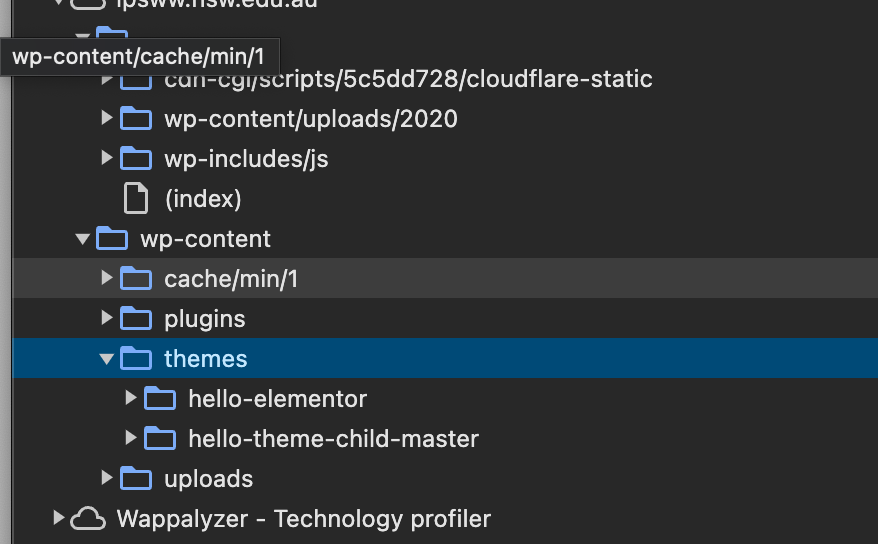
The theme name tells you what you are actually running. In the example above it is a well-known page-builder mega theme, not a bespoke build. If what you find surprises you, that is worth a conversation rather than an immediate rebuild.
Making the call
The custom versus template decision is not about what looks impressive, it is about what drives results. Templates serve businesses focused on speed to market and market validation. A custom build earns its cost the moment the template becomes the limiting factor. Your business stage, growth trajectory and specific functional needs should guide this, not budget alone.
Not sure whether a custom build or a well-executed template fits where your business is right now? We will look at your situation, your growth goals and what your competitors are doing, and give you a straight answer. If a template is the right call, we will tell you that. Book a call, or see how we approach web design in Cairns.